Projects Managed
Update of the Nickel Water Quality Guidelines (WQG) in Australia and New Zealand
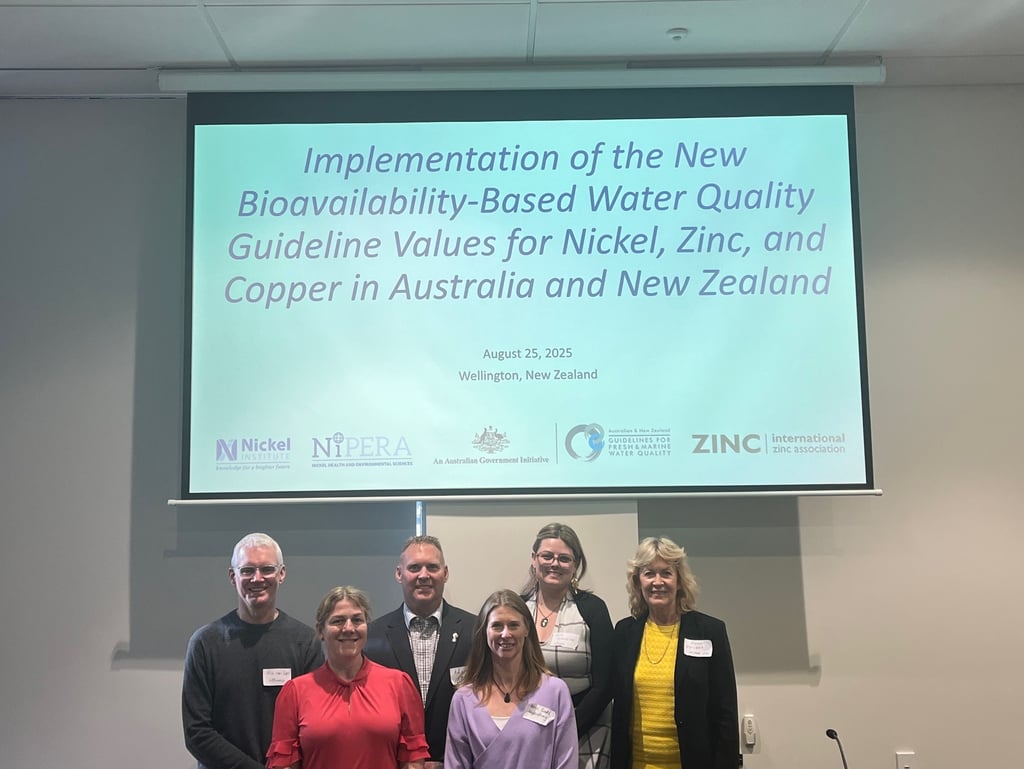
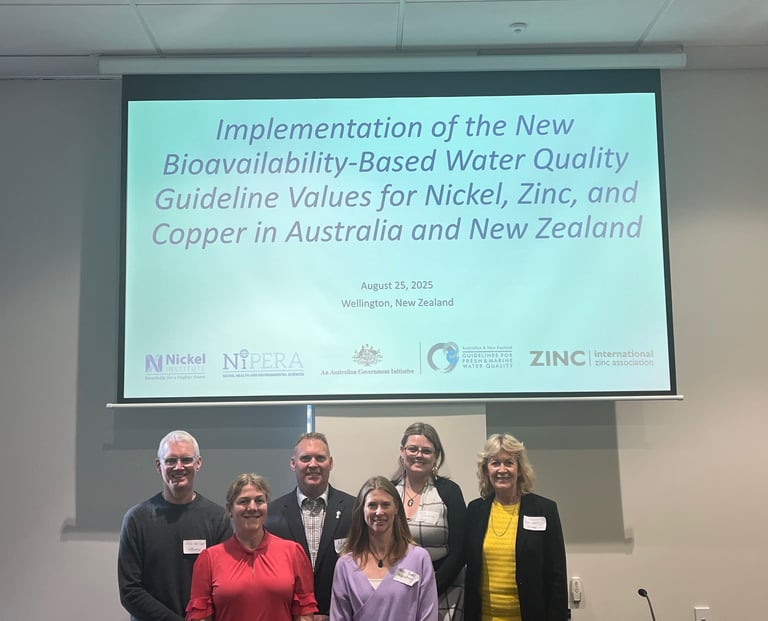
On behalf of the Nickel Institute, I led a multi-year effort to modernize the Nickel Water Quality Guidelines for Australia and New Zealand. This project required a deep dive into regional water chemistry to develop bioavailability-based standards using Multiple Linear Regression (MLR) models. I oversaw the synthesis of extensive datasets, including ecotoxicity profiles for native and endemic species, to ensure the resulting tools were both scientifically robust and practically applicable. Beyond modeling, I spearheaded the communication strategy for these new methodologies, organizing a global workshop, held in Wellington, New Zealand in August 2025, to bridge the gap between our technical findings and the regulatory expectations of consultants and government stakeholders worldwide.
Risk Assessment Framework Development
ASEAN, Emerging Economies
As one of the primary contributors on this document, I co-developed a comprehensive Risk Assessment Guidance Document for the ASEAN Regulatory Cooperation Platform (ARCP). This project was designed to establish a robust, accessible framework for stakeholders in the ASEAN region and other emerging economies that currently lack formalized regulatory structures. I spearheaded the environmental risk assessment sections, from data collection and data quality evaluation to hazard and exposure assessment methodologies. My work provided these jurisdictions with a clear roadmap for both qualitative and quantitative risk characterizations, as well as actionable remediation options. This guidance is expected to serve as a foundational pillar for regional harmonized chemical management and sustainable environmental health policy.
Climate Change & Metals Risk Assessment
On behalf of the International Council on Mining and Metals (ICMM) and a coalition of global metals associations, I led a forward-looking initiative to evaluate how climate change will alter the landscape of environmental risk assessments. As the project lead, I coordinated a multidisciplinary team of five subject matter experts to investigate the intersection of geochemical shifts, altered bioavailability, and evolving exposure pathways. Our research demonstrated that without accounting for climate-driven changes in water and soil chemistry, the potential for misattributing toxicity or environmental impact to metals is significant. This landmark report was delivered as a formal ICMM resource and is currently being integrated into the updated Metals Environmental Risk Assessment Guidance (MERAG), the definitive global framework for metals-specific regulatory compliance.
Update of US EPA’s Ambient Water Quality Criteria (WQC) for Ni, Zn and Pb
EU REACH Registration & Substance Maintenance (Nickel Consortium)
As the environmental toxicology lead for annual EU REACH registration updates, I managed the end-to-end technical review and integration of newly published ecotoxicity data for the nickel substance portfolio. This involved performing rigorous data quality scoring using Klimisch and CRED frameworks to ensure all evidence met ECHA’s high standards for regulatory reliability. My work focused on the derivation and update of Predicted No-Effect Concentrations (PNECs) for freshwater, marine, soil, and sediment compartments. I was responsible for the technical execution of these updates within IUCLID software, including the authoring of endpoint summaries and the generation of updated Chemical Safety Reports (CSRs) on behalf of the stakeholder consortium. This role required a precise balance of toxicological expertise and administrative diligence to ensure continued market access and regulatory compliance.
Regulatory Tool and Database Development
(bio-met / EU Freshwater Database)
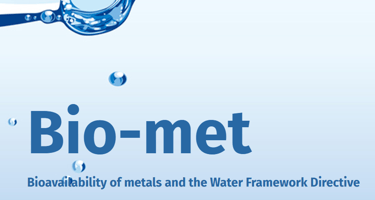
I served as the project lead for a comprehensive overhaul of the bio-met tool, the European Commission-recommended software for bioavailability-based EQS compliance assessments. This multi-stakeholder initiative involved migrating advanced computational models into a more resilient, user-friendly platform with enhanced data-exporting capabilities for regulatory submissions.
In tandem, I led the development of the Physicochemical Database of European Freshwaters, a massive data-integration project that collated over one million data points from primarily member-state monitoring programs. By strategically matching pH, hardness, and DOC parameters, this database leverages a technical foundation that allows for precise bioavailability calculations and the mapping of regional water sensitivities across Europe. These tools now provide the functional basis for both regulators and industry to perform environmental risk characterizations.
Update of the Nickel Environmental Quality Standards (EQS) in Europe
I served as the primary point of contact and technical liaison between the U.S. EPA and a coalition of eight metals associations operating under a formal Collaborative Research and Development Agreement (CRADA). My role was to bridge the gap between best-available science—specifically, the integration of bioavailability into regulatory frameworks—and the ongoing revision of the EPA’s Ambient Water Quality Criteria (AWQC) under the Clean Water Act. This project required intense cross-stakeholder communication, the curation of transparent, high-integrity databases, and a rigorous technical review of all models and criteria derivations. By maintaining a transparent and science-first approach, I ensured that the data generated by the metals associations was not only technically sound but readily applicable to the EPA's policy-making and regulatory objectives.
During the European Commission’s revision of Nickel Environmental Quality Standards (EQS), I led the technical and strategic response for the Nickel Institute to ensure the proposed updates aligned with best scientific practices. Recognizing that the initial proposal lacked scientific rigor, I initiated and managed several research and data integration projects to develop robust advocacy materials, which were subsequently published in peer-reviewed literature and presented to stakeholders across all levels of EU governance. To broaden the impact of our scientific arguments, I commissioned a comprehensive report evaluating the potential economic detriments of the proposal. By intentionally bridging toxicology with economic reality, I was able to capture the attention of high-level policy-makers and provide a more holistic, defensible counter-argument to the proposed regulations.
Document Repository & Project Management
(Metals Environmental Research Associations)
On behalf of a long-standing consortium of global metals associations, I spearheaded a major digital transformation of the Metals Environmental Research Associations (MERA) historical archives. This group had generated over two decades of critical research and project data without a cohesive file management system. I took on the initiative to design and build a custom, high-functioning data repository using Microsoft SharePoint, implementing a novel metadata architecture that allows users to search across vast libraries simultaneously. To ensure the system’s utility, I retroactively categorized over 2,000 legacy files by project keywords, sponsors, and technical leads. This infrastructure now serves as the central hub for global collaboration, integrating project calendars and granular permission controls that facilitate seamless document review between internal teams and external contractors.
Contact
Phone
© 2026 Traudtfish Environmental LLC. All rights reserved. All content, including text, images, and graphics, is the exclusive property of Traudtfish Environmental LLC and is protected by copyright law. Unauthorized reproduction, distribution, modification, or use of any material without prior written permission is strictly prohibited.
DUNS # 14-447-9959